Somewhere in your organization’s shared drives, email attachments, and, let’s be honest, a few physical folders, sits one of the most valuable and least understood asset classes a company holds: its contracts. But why? We have a contract management tool! Yes. But how many of the KPIs from your contracts are actually in there?
Every corporation, bank, and insurer manages hundreds, sometimes thousands, of active vendor contracts at any given time. IT agreements, facility management services, data providers, outsourced functions – the list is long, and the volume only grows as organizations scale. Each of these contracts contains obligations, commitments, pricing terms, penalty clauses, renewal triggers, and dozens of other details that directly shape cost and risk. Collectively, they represent a significant portion of an organization’s cost base and risk exposure.
And yet, almost none of this information exists in structured, queryable form.
The Cost of Not Knowing What’s in Your Contracts
The numbers make this concrete. According to the World Commerce & Contracting, the average organization loses 9.2% of its annual revenue through missed deadlines, unfavorable renewals, and overlooked terms. For most companies, it’s one of the largest sources of avoidable financial leakage on the books, and it rarely shows up as a single line item anywhere.
The reason is structural, not a lack of effort. Contract data is locked away in PDFs on shared drives, buried in email threads, or scattered across formats and languages with no consistent structure. Nobody is deliberately ignoring this information, it’s simply inaccessible at the scale required to act on it.
Why Generic AI Tools Fall Short
It’s tempting to assume this is already solved – after all, generic large language models can summarize a contract in seconds. But summarizing isn’t the same as extracting. What finance, procurement, and legal teams actually need isn’t a paragraph describing what a contract “generally covers” – it’s the exact auto-renewal trigger date, the precise SLA penalty threshold, or the price escalation mechanism buried in a subordinate clause on page 42.
Now multiply that requirement across 300 contracts, in different formats, different languages, and different negotiating styles from different vendors over different years. This is precisely where contract KPI extraction needs to go far beyond what a general-purpose summarization tool can reliably deliver. Consistency and precision at scale – not a fluent-sounding summary – is what actually protects revenue.
The Real-World Consequences
When contract data stays locked away, the effects compound quietly across the business:
- Decisions get made without full information – because nobody can see every relevant clause across every relevant contract at the moment a decision is needed.
- Renewals get missed – because auto-renewal dates sit unnoticed in a document nobody reviews until it’s too late.
- Cost optimization opportunities stay invisible – because pricing escalation clauses, volume discounts, and penalty thresholds are never compared systematically across the full vendor portfolio.
None of this is due to a lack of diligence. It’s a structural data problem: the information genuinely exists, but it was never unlocked in a form that made it usable.
From Static Contracts to a Live KPI Layer
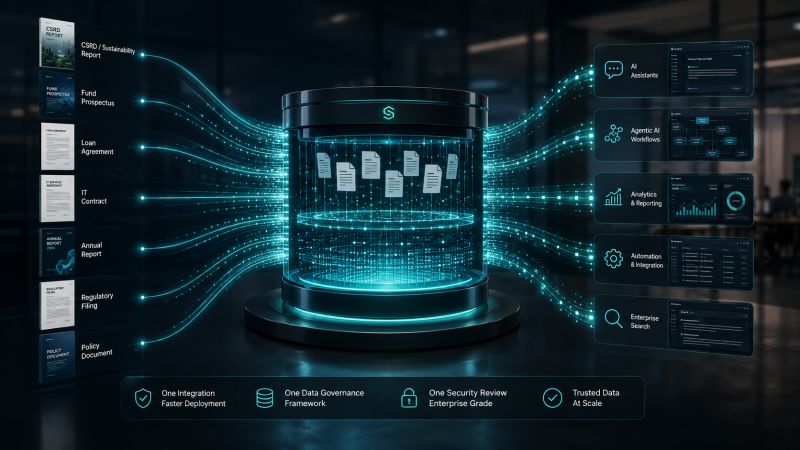
This is exactly where contract lifecycle intelligence changes the equation. Turning a contract portfolio into structured, queryable data means every renewal trigger, every SLA threshold, every pricing mechanism becomes something a finance or procurement team can query, monitor, and act on proactively – instead of discovering it only after a deadline has already passed. It´s not about changing your beloved contract management system- it´s about giving it its full potential.
The shift is from treating contracts as static legal documents filed away after signing, to treating them as a live, structured dataset that continuously informs cost management, risk exposure, and negotiation strategy. That’s the real promise of moving unstructured contract data into a system built for scale and precision.
A Question Worth Sitting With
So here’s a question worth genuinely thinking through: how much could your organization gain in 2026 from having full KPI-level transparency across every contract it holds?
For most organizations, the honest answer is: more than they currently assume – precisely because the data has never been visible enough to measure.
Curious what full contract transparency could look like for your organization? Get in touch with our team – we’re happy to talk it through.